
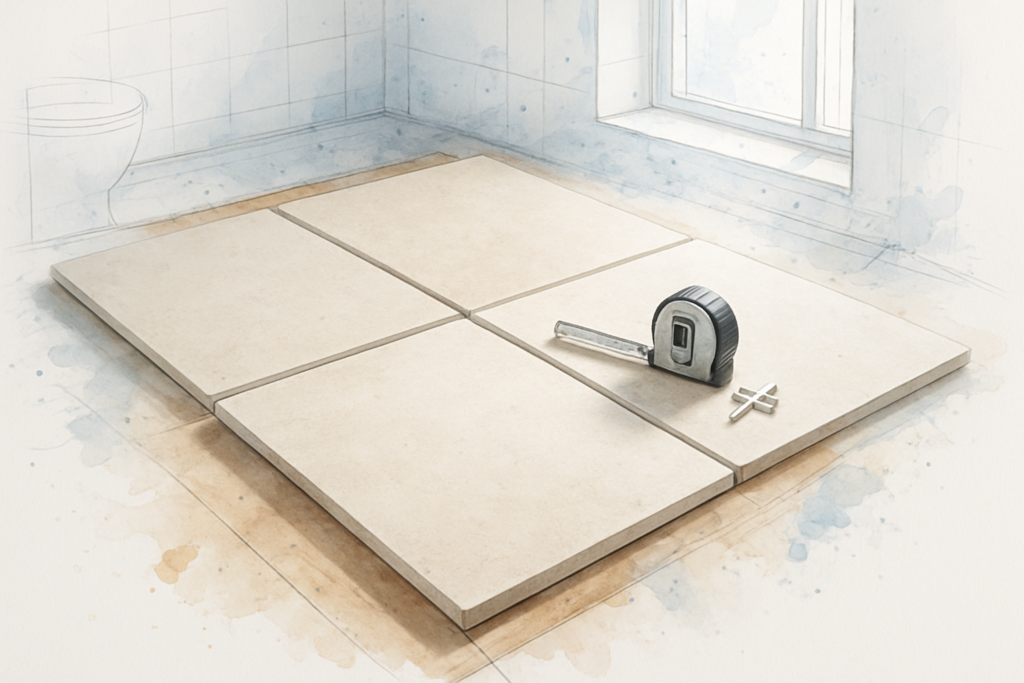
Direct Answer: Pietra di Ostuni tile is an Italian porcelain that reproduces the look of Ostuni limestone from Puglia. The body is porcelain, so it needs no sealing and will not etch.
You found Pietra di Ostuni online, read through the technical data sheet, and pictured a quarried Italian limestone floor in your primary bath. Then someone told you it was porcelain and the whole plan felt shaky.
Both things are true, and the confusion is built into the name. Pietra di Ostuni is a real limestone, quarried around the town of Ostuni in the province of Brindisi, in Italy’s Puglia region. The tile collection sold under that name is Italian porcelain made to reproduce that soft, fossil-flecked look, with the design drawn from the old whitewashed houses of the Salento area.
That distinction changes almost everything about how the tile behaves in a Carmel bathroom or a Pacific Grove entry. Below is what the porcelain body actually buys you, what the published specs mean once they hit a real floor, and where this material earns its place.
Porcelain Body, Limestone Look: What That Swap Actually Changes
A soft limestone in this same visual family is a lovely material with a real maintenance schedule. Porcelain in the same look behaves very differently once it is on the floor.
Here is what the porcelain body changes for the owner:
- No sealing schedule. A limestone floor gets sealed on install and resealed on a cycle. Porcelain does not take a penetrating sealer because there is nothing for it to soak into.
- No etch marks. Lemon juice on a bath counter, a splash of wine, a household cleaner left sitting overnight. On a calcium-based stone those leave dull spots. On porcelain they do not.
- Far more predictable behavior. The tile you set today reads the same in five years, which is not always the honest answer with soft stone in a heavy-use room.
None of that makes natural stone the wrong choice. Plenty of Monterey Peninsula homeowners want the depth and repairability only real stone gives you, and there is a good case for it. If you are weighing that side, our piece on limestone tile under real use covers the softness and sealing tradeoffs directly.
But if you loved the look and flinched at the upkeep, this collection is the version of that look that skips the upkeep conversation entirely.

Reading the Spec Sheet Without a Decoder Ring
The published technical data for this collection is more useful than most, and almost nobody puts it in plain language. Treat these as spec sheet figures you should confirm against the current data sheet for your exact color and size, since numbers shift by production run.
Spec sheets for the collection generally list:
- A DCOF around 0.78, which is a wet traction measurement
- Water absorption at or below 0.5 percent
- Frost resistance
- A V4 shade variation rating, meaning substantial variation
The DCOF number is the one worth understanding. Dynamic coefficient of friction is measured wet, and the standard threshold used across the industry for level interior floors expected to get wet is 0.42, a figure set out in ANSI A137.1 and explained by the Tile Council of North America. A reading near 0.78 is well clear of that line.
That matters in a Pacific Grove or Carmel bathroom that never fully dries out during marine layer season. Near-zero absorption matters because the tile is not drinking up water in a shower pan or on a covered patio.
And V4 is the number people ignore at their own cost. Two tiles out of the same box can differ noticeably in tone and fossil pattern.
Spec Sheet Figures Translated
Here is what the published numbers mean once the tile is in a real Central Coast project. Confirm the current figures for your specific color and format before you order.
| Spec figure | What it measures | What it means on your project |
|---|---|---|
| DCOF around 0.78 | Wet slip resistance | Strong traction on a bath floor that stays damp through fog season |
| Water absorption 0.5% or less | How much water the body takes in | No sealing schedule, works in showers and covered outdoor areas |
| Frost resistant | Freeze and thaw durability | Holds up on Carmel Valley and Salinas patios where nights run colder than the fog belt |
| V4 shade variation | Tile-to-tile color and pattern range | Dry-lay a few square feet before setting and buy from one production lot |
| Matte natural finish | Surface texture | The finish to use anywhere water sits. Slicker finishes belong on walls |
Color and Format: How the Room Actually Reads
The palette runs through warm neutrals, most commonly Avorio, Tufo, Sabbia, and Grigio. Field sizes generally cover 8×8, 8×16, 16×16, and 16×24, with mosaic sheets and decorative Trame pieces for accent runs.
Format changes the feel of the room more than color does. A recent design-team request came in for 308 square feet of Tufo in 16×24 with a 1/8 inch biscuit grout joint, which is a realistic shape for a primary bath floor plus a wall run.
- 16×24 field: fewer grout lines, a calmer and more contemporary read, and the V4 variation spreads across bigger pieces so the floor looks like one surface
- 16×16 and 8×16: middle ground, still modern but with more visible rhythm
- 8×8 squares: leans rustic and pulls the Salento reference forward, closer to an old Puglia courtyard floor
- Mosaic and Trame pieces: shower pans, niches, and accent bands where you want texture change without a material change
Grout color does as much work as tile color here. A biscuit or greige joint lets the field read as continuous. A high-contrast grout turns the same tile into a grid, which is a fine look, just a very different one.
Where This Tile Belongs and Where to Be Careful
A quick map of the applications this porcelain handles well, and the two places where the finish decision matters most.

Running the Same Look Indoors and Out on the Peninsula
This is where the porcelain version pulls ahead for Monterey Peninsula and Bay Area projects. Because the same face is available in a frost-resistant body, you can run a bathroom floor out to a terrace or carry an entry through to a covered patio without switching materials at the threshold.
That is harder than it sounds with natural stone, where the exterior-rated version of a limestone often reads differently than the polished interior tile.
The wet season here runs roughly October through March, and exterior surfaces on the Peninsula stay damp for weeks at a stretch. Fog drip under a Pebble Beach oak canopy keeps a walkway wet long after the last rain.
So be honest about finish:
- Matte natural surface is the one that holds traction where water sits. Steps, pool surrounds, entries, bath floors.
- Slicker or polished finishes belong on walls and vertical runs, not underfoot outdoors.
Inland projects in Carmel Valley and Salinas see colder nights than the fog belt does, and that is exactly where the frost resistance rating earns its keep. A tile that absorbs water and then freezes is a tile that spalls.
Stock, Lots, and Lead Times
Two ordering realities come up constantly on the phone, and both are easy to plan around if you know them early.
First, confirm what is actually on the floor before you fall in love with a format. Callers regularly ask whether a material they saw online is in stock right now in the size and finish they want. Several with tight construction schedules have backed off after learning that special-order import timelines can run roughly 90 to 120 days.
Second, order your overage in a single production lot. A follow-up order placed months later comes from a different run, and shade can shift. One recurring caller line sums up the whole risk: “I need it to match what I already have.”
That is doubly true with a V4 rating. We covered the mechanics of this in why your second tile order won’t match, including how much attic stock to keep on hand.
Who Owns Which Decision
Roughly one in twelve callers asks some version of whether the tile supplier also installs. Knowing the split lets you ask the right questions of the right person.
- The supplier sells and delivers the tile, provides take-home samples, confirms what is in stock, and can point you toward a setter or fabricator.
- Your tile installer owns substrate prep, waterproofing, movement joints, layout, and setting.
That line matters more with this material than with a small-format tile. Large-format porcelain in a wet room lives or dies on mortar coverage and layout planning, not on the tile itself. A 16×24 piece set with voids under it will sound hollow and can crack under a dropped shampoo bottle.
Our breakdown of what a large-format install actually demands is worth forwarding to your contractor before layout day, along with who handles what in a remodel if this is your first tile project.
Frequently Asked Questions About Pietra di Ostuni Tile
Is Pietra di Ostuni tile real stone or porcelain?
The collection sold under that name is porcelain made in Italy. Pietra di Ostuni itself is a real limestone quarried near Ostuni in Puglia, and the tile is designed to reproduce that fossil-flecked look. Check the product data sheet for the body type before you order.
Does it need to be sealed?
No. The porcelain body absorbs almost no water, so a penetrating sealer has nothing to penetrate. Your grout may be a different conversation, and your installer should weigh in on whether a grout sealer makes sense for your joint width and location.
Can I use it on a patio or pool deck in Carmel?
Usually yes, if you stay with the matte natural finish and confirm the frost resistance rating for the exact color and size you are ordering. Anywhere water sits or someone steps barefoot on a wet surface, traction is the deciding factor, not appearance.
What does a V4 rating mean for my floor?
It means substantial variation from tile to tile. Two pieces from the same box can differ noticeably in tone and fossil pattern, which is the point of the look, but it also means dry-laying a few square feet before setting is not optional. A catalogue photo shows one tile and tells you very little about how 300 square feet will read.
How much should I order beyond my square footage?
Talk that number through with your installer, since it depends on layout, cut waste, and whether you are running a diagonal or offset pattern. Whatever the figure, order it all at once from a single lot so your attic stock still matches years later.
Seeing a V4 Tile in Person Is Worth the Drive
With a V4 variation rating, a catalogue photo shows one tile and tells you almost nothing about how a 300 square foot floor will read across a room. The showrooms in Carmel and Palo Alto keep live inventory and take-home samples, and these collections are sourced directly from Italian producers rather than pulled from a generic catalogue, which is why color and finish stay consistent across the line. If you want to look at full boxes side by side before you commit to a format, Carmel Stone Imports can be reached at (650) 800-7840 or info@carmelimports.com.